Margin trading is a popular investment strategy that allows investors to increase their buying power by borrowing funds from a broker. While this approach can be beneficial for maximizing profits, it also carries risks that can result in losses.
One of the most significant risks associated with margin trading is the possibility of receiving a margin call. If you’re unfamiliar with this term, don’t worry. In this article, we’ll explain everything you need to know about margin calls, including what they are, how they work, and the potential risks associated with them.
What are Margin Calls?
When an investor engages in margin trading, they essentially borrow funds from their broker to purchase securities. This approach allows investors to increase their buying power, but it also means that they have to maintain a certain level of equity in their account.
A margin call occurs when the equity in an investor’s account falls below a certain level, also known as the maintenance margin. At this point, the broker will require the investor to deposit additional funds to bring their equity back up to the required level.
How do Margin Calls Work?
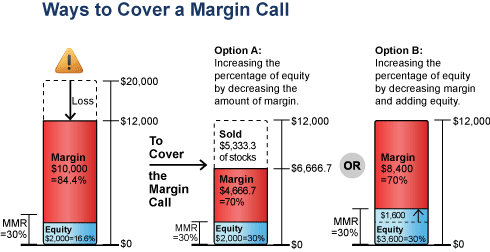
To better understand how margin calls work, let’s consider a hypothetical example. Let’s say that you have $10,000 in your account, and you want to purchase $20,000 worth of securities. With a 50% margin requirement, you would need to deposit $10,000 (50% of $20,000) in cash or securities.
Now let’s say that the value of your securities drops to $15,000. At this point, your equity in the account would be $5,000 (the value of your securities minus the amount you borrowed). If the maintenance margin is 25%, then your account would be required to maintain an equity of at least $3,750 (25% of $15,000).
Since your equity falls below the maintenance margin, your broker would issue a margin call requiring you to deposit additional funds to bring your equity back up to the required level. If you fail to deposit the additional funds, your broker may liquidate your securities to cover the outstanding balance.
What are the Risks of Margin Calls?
While margin trading can be a useful investment strategy, it’s important to understand the potential risks associated with margin calls. Here are some of the risks to consider:
- Loss of Investment: If you’re unable to deposit additional funds to cover a margin call, your broker may liquidate your securities to cover the outstanding balance. This can result in a loss of your entire investment.
- Increased Risk: Margin trading increases the risk of your investment by using borrowed funds. A drop in the value of your securities can quickly erode your equity and trigger a margin call.
- Interest Payments: When you borrow funds from your broker, you’ll be charged interest on the borrowed amount. This can eat into your profits and increase the risk of a margin call.
Heading 4: Frequently Asked Questions (continued)
- Q: Can I use margin trading for any type of security? A: Not all securities are eligible for margin trading, and the margin requirements can vary by security. It’s important to check with your broker to understand the specific requirements for the securities you’re interested in trading.
- Q: How much can I borrow through margin trading? A: The amount you can borrow through margin trading depends on the margin requirements set by your broker. Different securities may have different margin requirements, and your borrowing limit may also be affected by your account balance and trading experience.
Conclusion
- Margin calls are an inherent risk of margin trading, and it’s essential to understand how they work to avoid potential losses. By maintaining a sufficient level of equity in your account and monitoring your positions regularly, you can reduce the risk of receiving a margin call. However, it’s important to remember that margin trading is not suitable for everyone, and the risks involved should be carefully considered before engaging in this investment strategy.
- In summary, margin calls are a tool used by brokers to ensure that investors maintain a sufficient level of equity in their margin accounts. While they can be beneficial for reducing the risk of losses, they also carry risks that can result in significant losses. As with any investment strategy, it’s crucial to carefully evaluate the risks and benefits of margin trading before making any investment decisions.